Measuring Adaptedness is a long-form guide to measuring adaptedness. It examines fitness proxies, performance measures, benchmarks, comparative studies, and common errors., explains how the term is used, and shows how evidence should be interpreted across biological and non-biological settings.
Core idea
At its center, measuring adaptedness concerns fitness proxies, performance measures, benchmarks, comparative studies, and common errors.. The useful unit of analysis is not a trait in isolation but a relationship: a feature, behavior, organization, or system is evaluated against the conditions in which it operates. A thick coat may be advantageous in one climate and costly in another. A business process may be efficient under stable demand yet brittle during rapid change. A learning algorithm may excel on familiar data and fail under a new distribution. Adaptedness is therefore relational, conditional, and often local rather than absolute.
A careful account begins by identifying the entity, the environment, the outcome, and the time period. Without these four elements, claims about being well adapted can become vague praise rather than analysis. The entity might be a genotype, organism, population, ecosystem, person, institution, product, or model. The environment may include physical conditions, competitors, predators, social norms, regulations, technologies, and resource limits. The outcome must also be explicit: persistence, reproduction, accuracy, safety, efficiency, well-being, or some other measurable result.
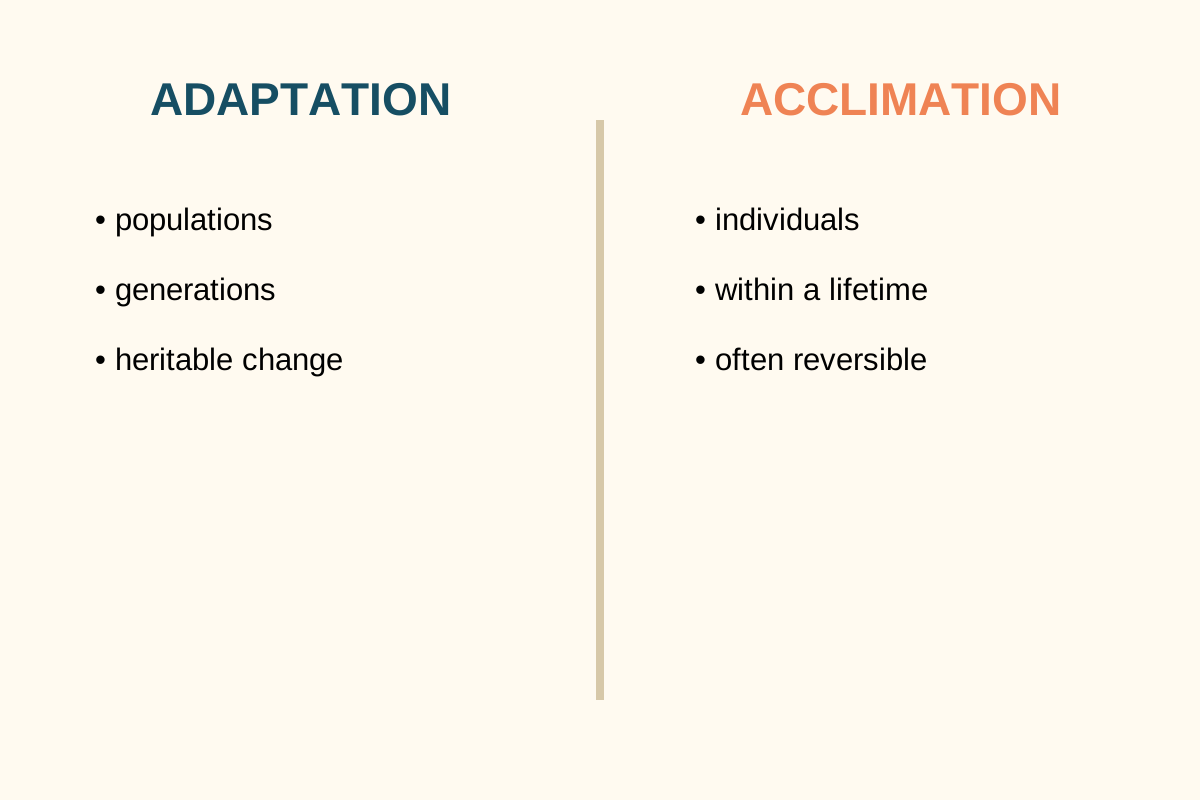
The word adaptation is frequently used as though it always describes the same process. It does not. In evolutionary biology, adaptation often refers to heritable change shaped by natural selection across generations, or to a trait maintained because it improved reproductive success in a particular context. In physiology, training, psychology, organizations, and technology, adaptation may refer to adjustment within a lifetime or operating period. These uses can be legitimate, but they should not be mixed without explanation.
Measuring adaptedness is rarely equivalent to perfection. Natural selection works with existing variation, inherited developmental systems, historical constraints, and chance. Organizations inherit structures, contracts, skills, and habits. Technologies are limited by materials, interfaces, standards, budgets, and prior design decisions. A good fit may therefore be the best available compromise rather than an ideal solution. This distinction prevents the mistake of treating every existing feature as optimally designed.
Why the concept matters
One of the most important principles is that benefits can carry costs. Greater speed may reduce endurance. Strong specialization may increase efficiency while reducing flexibility. Redundancy may improve resilience while increasing expense. A system optimized for average conditions may become vulnerable at extremes. Trade-offs do not mean that adaptation has failed; they reveal that performance occurs across multiple objectives and under limited resources.
Measurement should match the claim. In evolutionary studies, researchers may estimate reproductive success, survival, population growth, or changes in allele frequency. In physiology, they may examine tolerance, work capacity, recovery, or biomarker responses. In organizations, suitable measures could include service quality, cash flow, cycle time, error rates, employee retention, or survival through disruption. In artificial intelligence, accuracy alone may be insufficient; calibration, robustness, fairness, latency, and performance under distribution shift may matter.
Context changes through time. A trait that improved outcomes in the past can become neutral or harmful after climate, diet, predators, markets, technologies, or social institutions change. This is a central route to mismatch and maladaptation. The same logic applies beyond biology: a once-successful procedure can persist because of habit, sunk cost, or governance even after the environment that justified it has disappeared.
Evidence for measuring adaptedness is strongest when alternatives are compared. Researchers may compare populations across habitats, measure reciprocal performance, manipulate environmental variables, reconstruct historical change, or follow outcomes over generations. Decision makers can use pilot programs, controlled trials, scenario testing, stress tests, and post-implementation monitoring. A single success story is informative but rarely enough to establish a general explanation.
The environment is part of the definition
The distinction between explanation and storytelling is essential. After observing a feature, people can invent a plausible reason for it. A credible adaptive explanation requires evidence that the feature varies, affects outcomes, has the proposed history or mechanism, and performs differently under relevant conditions. Competing explanations—drift, correlation, constraint, by-product, learning, policy, or chance—should be considered rather than dismissed.
Adaptedness can be distributed unevenly. A policy may help one group while burdening another. A technology may fit experienced users but exclude people with disabilities. A climate adaptation project may protect high-value property while transferring flood risk elsewhere. Analysis should therefore ask who benefits, who bears costs, what assumptions define success, and whether short-term gains create long-term vulnerability.
A practical way to reason about measuring adaptedness is to map inputs, pressures, responses, outcomes, and feedback. Inputs include inherited traits, skills, resources, data, infrastructure, and prior experience. Pressures include scarcity, competition, hazards, uncertainty, and changing goals. Responses may be genetic, physiological, behavioral, cultural, organizational, or computational. Outcomes then influence future variation and decision making through selection, learning, investment, or institutional memory.
Generalization requires caution. A result observed in one population, climate, laboratory, company, or dataset may not transfer to another. Local adaptedness can create confidence that is unwarranted outside the tested domain. Replication across conditions, transparent reporting of boundaries, and explicit uncertainty are therefore central to understanding whether fit is broad, narrow, durable, or temporary.
Mechanisms and pathways
The concept also raises questions about agency. Evolutionary adaptation does not occur because organisms consciously need a trait. Physiological and behavioral adjustments can involve regulatory systems and learning, while organizational adaptation can involve deliberate planning and conflict. Artificial systems may update parameters without possessing goals of their own. Intentional language can be convenient, but it should not obscure the actual mechanism.
Historical perspective often changes interpretation. Present-day fit may depend on a sequence of earlier environments and path-dependent choices. Features can be retained because they are developmentally integrated with other features, because changing them would be costly, or because the system never encountered a viable alternative. Understanding history helps explain why adaptedness is often patchwork rather than cleanly engineered.
For readers evaluating a claim, five questions are especially useful. What exactly is said to be adapted? Adapted to what conditions? By what mechanism did the fit arise? Which outcomes demonstrate the fit? Under what conditions would the claim fail? These questions turn a broad idea into a testable and comparative statement.
The broad lesson is that measuring adaptedness should be described with precision and humility. Fit is real and measurable, but it is not timeless, universal, or automatically beneficial in every respect. Strong analysis identifies the relevant environment, distinguishes process from state, compares alternatives, measures outcomes, and remains alert to trade-offs, history, and change.
| Question | Why it matters |
|---|---|
| What is adapting? | Defines the unit of analysis. |
| Adapted to what? | Identifies the relevant environment. |
| By which mechanism? | Separates selection, regulation, learning, and design. |
| Measured how? | Connects the claim to outcomes. |
| Compared with what? | Prevents unsupported claims. |
Variation and comparison
At its center, measuring adaptedness concerns fitness proxies, performance measures, benchmarks, comparative studies, and common errors.. The useful unit of analysis is not a trait in isolation but a relationship: a feature, behavior, organization, or system is evaluated against the conditions in which it operates. A thick coat may be advantageous in one climate and costly in another. A business process may be efficient under stable demand yet brittle during rapid change. A learning algorithm may excel on familiar data and fail under a new distribution. Adaptedness is therefore relational, conditional, and often local rather than absolute.
A careful account begins by identifying the entity, the environment, the outcome, and the time period. Without these four elements, claims about being well adapted can become vague praise rather than analysis. The entity might be a genotype, organism, population, ecosystem, person, institution, product, or model. The environment may include physical conditions, competitors, predators, social norms, regulations, technologies, and resource limits. The outcome must also be explicit: persistence, reproduction, accuracy, safety, efficiency, well-being, or some other measurable result.
The word adaptation is frequently used as though it always describes the same process. It does not. In evolutionary biology, adaptation often refers to heritable change shaped by natural selection across generations, or to a trait maintained because it improved reproductive success in a particular context. In physiology, training, psychology, organizations, and technology, adaptation may refer to adjustment within a lifetime or operating period. These uses can be legitimate, but they should not be mixed without explanation.
Measuring adaptedness is rarely equivalent to perfection. Natural selection works with existing variation, inherited developmental systems, historical constraints, and chance. Organizations inherit structures, contracts, skills, and habits. Technologies are limited by materials, interfaces, standards, budgets, and prior design decisions. A good fit may therefore be the best available compromise rather than an ideal solution. This distinction prevents the mistake of treating every existing feature as optimally designed.
Time scales
One of the most important principles is that benefits can carry costs. Greater speed may reduce endurance. Strong specialization may increase efficiency while reducing flexibility. Redundancy may improve resilience while increasing expense. A system optimized for average conditions may become vulnerable at extremes. Trade-offs do not mean that adaptation has failed; they reveal that performance occurs across multiple objectives and under limited resources.
Measurement should match the claim. In evolutionary studies, researchers may estimate reproductive success, survival, population growth, or changes in allele frequency. In physiology, they may examine tolerance, work capacity, recovery, or biomarker responses. In organizations, suitable measures could include service quality, cash flow, cycle time, error rates, employee retention, or survival through disruption. In artificial intelligence, accuracy alone may be insufficient; calibration, robustness, fairness, latency, and performance under distribution shift may matter.
Context changes through time. A trait that improved outcomes in the past can become neutral or harmful after climate, diet, predators, markets, technologies, or social institutions change. This is a central route to mismatch and maladaptation. The same logic applies beyond biology: a once-successful procedure can persist because of habit, sunk cost, or governance even after the environment that justified it has disappeared.
Evidence for measuring adaptedness is strongest when alternatives are compared. Researchers may compare populations across habitats, measure reciprocal performance, manipulate environmental variables, reconstruct historical change, or follow outcomes over generations. Decision makers can use pilot programs, controlled trials, scenario testing, stress tests, and post-implementation monitoring. A single success story is informative but rarely enough to establish a general explanation.
Trade-offs and constraints
The distinction between explanation and storytelling is essential. After observing a feature, people can invent a plausible reason for it. A credible adaptive explanation requires evidence that the feature varies, affects outcomes, has the proposed history or mechanism, and performs differently under relevant conditions. Competing explanations—drift, correlation, constraint, by-product, learning, policy, or chance—should be considered rather than dismissed.
Adaptedness can be distributed unevenly. A policy may help one group while burdening another. A technology may fit experienced users but exclude people with disabilities. A climate adaptation project may protect high-value property while transferring flood risk elsewhere. Analysis should therefore ask who benefits, who bears costs, what assumptions define success, and whether short-term gains create long-term vulnerability.
A practical way to reason about measuring adaptedness is to map inputs, pressures, responses, outcomes, and feedback. Inputs include inherited traits, skills, resources, data, infrastructure, and prior experience. Pressures include scarcity, competition, hazards, uncertainty, and changing goals. Responses may be genetic, physiological, behavioral, cultural, organizational, or computational. Outcomes then influence future variation and decision making through selection, learning, investment, or institutional memory.
Generalization requires caution. A result observed in one population, climate, laboratory, company, or dataset may not transfer to another. Local adaptedness can create confidence that is unwarranted outside the tested domain. Replication across conditions, transparent reporting of boundaries, and explicit uncertainty are therefore central to understanding whether fit is broad, narrow, durable, or temporary.
Evidence and measurement
The concept also raises questions about agency. Evolutionary adaptation does not occur because organisms consciously need a trait. Physiological and behavioral adjustments can involve regulatory systems and learning, while organizational adaptation can involve deliberate planning and conflict. Artificial systems may update parameters without possessing goals of their own. Intentional language can be convenient, but it should not obscure the actual mechanism.
Historical perspective often changes interpretation. Present-day fit may depend on a sequence of earlier environments and path-dependent choices. Features can be retained because they are developmentally integrated with other features, because changing them would be costly, or because the system never encountered a viable alternative. Understanding history helps explain why adaptedness is often patchwork rather than cleanly engineered.
For readers evaluating a claim, five questions are especially useful. What exactly is said to be adapted? Adapted to what conditions? By what mechanism did the fit arise? Which outcomes demonstrate the fit? Under what conditions would the claim fail? These questions turn a broad idea into a testable and comparative statement.
The broad lesson is that measuring adaptedness should be described with precision and humility. Fit is real and measurable, but it is not timeless, universal, or automatically beneficial in every respect. Strong analysis identifies the relevant environment, distinguishes process from state, compares alternatives, measures outcomes, and remains alert to trade-offs, history, and change.
Examples in practice
At its center, measuring adaptedness concerns fitness proxies, performance measures, benchmarks, comparative studies, and common errors.. The useful unit of analysis is not a trait in isolation but a relationship: a feature, behavior, organization, or system is evaluated against the conditions in which it operates. A thick coat may be advantageous in one climate and costly in another. A business process may be efficient under stable demand yet brittle during rapid change. A learning algorithm may excel on familiar data and fail under a new distribution. Adaptedness is therefore relational, conditional, and often local rather than absolute.
A careful account begins by identifying the entity, the environment, the outcome, and the time period. Without these four elements, claims about being well adapted can become vague praise rather than analysis. The entity might be a genotype, organism, population, ecosystem, person, institution, product, or model. The environment may include physical conditions, competitors, predators, social norms, regulations, technologies, and resource limits. The outcome must also be explicit: persistence, reproduction, accuracy, safety, efficiency, well-being, or some other measurable result.
The word adaptation is frequently used as though it always describes the same process. It does not. In evolutionary biology, adaptation often refers to heritable change shaped by natural selection across generations, or to a trait maintained because it improved reproductive success in a particular context. In physiology, training, psychology, organizations, and technology, adaptation may refer to adjustment within a lifetime or operating period. These uses can be legitimate, but they should not be mixed without explanation.
Measuring adaptedness is rarely equivalent to perfection. Natural selection works with existing variation, inherited developmental systems, historical constraints, and chance. Organizations inherit structures, contracts, skills, and habits. Technologies are limited by materials, interfaces, standards, budgets, and prior design decisions. A good fit may therefore be the best available compromise rather than an ideal solution. This distinction prevents the mistake of treating every existing feature as optimally designed.
| Question | Why it matters |
|---|---|
| What is adapting? | Defines the unit of analysis. |
| Adapted to what? | Identifies the relevant environment. |
| By which mechanism? | Separates selection, regulation, learning, and design. |
| Measured how? | Connects the claim to outcomes. |
| Compared with what? | Prevents unsupported claims. |
Common misunderstandings
One of the most important principles is that benefits can carry costs. Greater speed may reduce endurance. Strong specialization may increase efficiency while reducing flexibility. Redundancy may improve resilience while increasing expense. A system optimized for average conditions may become vulnerable at extremes. Trade-offs do not mean that adaptation has failed; they reveal that performance occurs across multiple objectives and under limited resources.
Measurement should match the claim. In evolutionary studies, researchers may estimate reproductive success, survival, population growth, or changes in allele frequency. In physiology, they may examine tolerance, work capacity, recovery, or biomarker responses. In organizations, suitable measures could include service quality, cash flow, cycle time, error rates, employee retention, or survival through disruption. In artificial intelligence, accuracy alone may be insufficient; calibration, robustness, fairness, latency, and performance under distribution shift may matter.
Context changes through time. A trait that improved outcomes in the past can become neutral or harmful after climate, diet, predators, markets, technologies, or social institutions change. This is a central route to mismatch and maladaptation. The same logic applies beyond biology: a once-successful procedure can persist because of habit, sunk cost, or governance even after the environment that justified it has disappeared.
Evidence for measuring adaptedness is strongest when alternatives are compared. Researchers may compare populations across habitats, measure reciprocal performance, manipulate environmental variables, reconstruct historical change, or follow outcomes over generations. Decision makers can use pilot programs, controlled trials, scenario testing, stress tests, and post-implementation monitoring. A single success story is informative but rarely enough to establish a general explanation.
Applications
The distinction between explanation and storytelling is essential. After observing a feature, people can invent a plausible reason for it. A credible adaptive explanation requires evidence that the feature varies, affects outcomes, has the proposed history or mechanism, and performs differently under relevant conditions. Competing explanations—drift, correlation, constraint, by-product, learning, policy, or chance—should be considered rather than dismissed.
Adaptedness can be distributed unevenly. A policy may help one group while burdening another. A technology may fit experienced users but exclude people with disabilities. A climate adaptation project may protect high-value property while transferring flood risk elsewhere. Analysis should therefore ask who benefits, who bears costs, what assumptions define success, and whether short-term gains create long-term vulnerability.
A practical way to reason about measuring adaptedness is to map inputs, pressures, responses, outcomes, and feedback. Inputs include inherited traits, skills, resources, data, infrastructure, and prior experience. Pressures include scarcity, competition, hazards, uncertainty, and changing goals. Responses may be genetic, physiological, behavioral, cultural, organizational, or computational. Outcomes then influence future variation and decision making through selection, learning, investment, or institutional memory.
Generalization requires caution. A result observed in one population, climate, laboratory, company, or dataset may not transfer to another. Local adaptedness can create confidence that is unwarranted outside the tested domain. Replication across conditions, transparent reporting of boundaries, and explicit uncertainty are therefore central to understanding whether fit is broad, narrow, durable, or temporary.
Ethical and social considerations
The concept also raises questions about agency. Evolutionary adaptation does not occur because organisms consciously need a trait. Physiological and behavioral adjustments can involve regulatory systems and learning, while organizational adaptation can involve deliberate planning and conflict. Artificial systems may update parameters without possessing goals of their own. Intentional language can be convenient, but it should not obscure the actual mechanism.
Historical perspective often changes interpretation. Present-day fit may depend on a sequence of earlier environments and path-dependent choices. Features can be retained because they are developmentally integrated with other features, because changing them would be costly, or because the system never encountered a viable alternative. Understanding history helps explain why adaptedness is often patchwork rather than cleanly engineered.
For readers evaluating a claim, five questions are especially useful. What exactly is said to be adapted? Adapted to what conditions? By what mechanism did the fit arise? Which outcomes demonstrate the fit? Under what conditions would the claim fail? These questions turn a broad idea into a testable and comparative statement.
The broad lesson is that measuring adaptedness should be described with precision and humility. Fit is real and measurable, but it is not timeless, universal, or automatically beneficial in every respect. Strong analysis identifies the relevant environment, distinguishes process from state, compares alternatives, measures outcomes, and remains alert to trade-offs, history, and change.
How to analyze a claim
At its center, measuring adaptedness concerns fitness proxies, performance measures, benchmarks, comparative studies, and common errors.. The useful unit of analysis is not a trait in isolation but a relationship: a feature, behavior, organization, or system is evaluated against the conditions in which it operates. A thick coat may be advantageous in one climate and costly in another. A business process may be efficient under stable demand yet brittle during rapid change. A learning algorithm may excel on familiar data and fail under a new distribution. Adaptedness is therefore relational, conditional, and often local rather than absolute.
A careful account begins by identifying the entity, the environment, the outcome, and the time period. Without these four elements, claims about being well adapted can become vague praise rather than analysis. The entity might be a genotype, organism, population, ecosystem, person, institution, product, or model. The environment may include physical conditions, competitors, predators, social norms, regulations, technologies, and resource limits. The outcome must also be explicit: persistence, reproduction, accuracy, safety, efficiency, well-being, or some other measurable result.
The word adaptation is frequently used as though it always describes the same process. It does not. In evolutionary biology, adaptation often refers to heritable change shaped by natural selection across generations, or to a trait maintained because it improved reproductive success in a particular context. In physiology, training, psychology, organizations, and technology, adaptation may refer to adjustment within a lifetime or operating period. These uses can be legitimate, but they should not be mixed without explanation.
Measuring adaptedness is rarely equivalent to perfection. Natural selection works with existing variation, inherited developmental systems, historical constraints, and chance. Organizations inherit structures, contracts, skills, and habits. Technologies are limited by materials, interfaces, standards, budgets, and prior design decisions. A good fit may therefore be the best available compromise rather than an ideal solution. This distinction prevents the mistake of treating every existing feature as optimally designed.
Questions researchers ask
One of the most important principles is that benefits can carry costs. Greater speed may reduce endurance. Strong specialization may increase efficiency while reducing flexibility. Redundancy may improve resilience while increasing expense. A system optimized for average conditions may become vulnerable at extremes. Trade-offs do not mean that adaptation has failed; they reveal that performance occurs across multiple objectives and under limited resources.
Measurement should match the claim. In evolutionary studies, researchers may estimate reproductive success, survival, population growth, or changes in allele frequency. In physiology, they may examine tolerance, work capacity, recovery, or biomarker responses. In organizations, suitable measures could include service quality, cash flow, cycle time, error rates, employee retention, or survival through disruption. In artificial intelligence, accuracy alone may be insufficient; calibration, robustness, fairness, latency, and performance under distribution shift may matter.
Context changes through time. A trait that improved outcomes in the past can become neutral or harmful after climate, diet, predators, markets, technologies, or social institutions change. This is a central route to mismatch and maladaptation. The same logic applies beyond biology: a once-successful procedure can persist because of habit, sunk cost, or governance even after the environment that justified it has disappeared.
Evidence for measuring adaptedness is strongest when alternatives are compared. Researchers may compare populations across habitats, measure reciprocal performance, manipulate environmental variables, reconstruct historical change, or follow outcomes over generations. Decision makers can use pilot programs, controlled trials, scenario testing, stress tests, and post-implementation monitoring. A single success story is informative but rarely enough to establish a general explanation.
| Question | Why it matters |
|---|---|
| What is adapting? | Defines the unit of analysis. |
| Adapted to what? | Identifies the relevant environment. |
| By which mechanism? | Separates selection, regulation, learning, and design. |
| Measured how? | Connects the claim to outcomes. |
| Compared with what? | Prevents unsupported claims. |
A practical framework
The distinction between explanation and storytelling is essential. After observing a feature, people can invent a plausible reason for it. A credible adaptive explanation requires evidence that the feature varies, affects outcomes, has the proposed history or mechanism, and performs differently under relevant conditions. Competing explanations—drift, correlation, constraint, by-product, learning, policy, or chance—should be considered rather than dismissed.
Adaptedness can be distributed unevenly. A policy may help one group while burdening another. A technology may fit experienced users but exclude people with disabilities. A climate adaptation project may protect high-value property while transferring flood risk elsewhere. Analysis should therefore ask who benefits, who bears costs, what assumptions define success, and whether short-term gains create long-term vulnerability.
A practical way to reason about measuring adaptedness is to map inputs, pressures, responses, outcomes, and feedback. Inputs include inherited traits, skills, resources, data, infrastructure, and prior experience. Pressures include scarcity, competition, hazards, uncertainty, and changing goals. Responses may be genetic, physiological, behavioral, cultural, organizational, or computational. Outcomes then influence future variation and decision making through selection, learning, investment, or institutional memory.
Generalization requires caution. A result observed in one population, climate, laboratory, company, or dataset may not transfer to another. Local adaptedness can create confidence that is unwarranted outside the tested domain. Replication across conditions, transparent reporting of boundaries, and explicit uncertainty are therefore central to understanding whether fit is broad, narrow, durable, or temporary.
Summary
The concept also raises questions about agency. Evolutionary adaptation does not occur because organisms consciously need a trait. Physiological and behavioral adjustments can involve regulatory systems and learning, while organizational adaptation can involve deliberate planning and conflict. Artificial systems may update parameters without possessing goals of their own. Intentional language can be convenient, but it should not obscure the actual mechanism.
Historical perspective often changes interpretation. Present-day fit may depend on a sequence of earlier environments and path-dependent choices. Features can be retained because they are developmentally integrated with other features, because changing them would be costly, or because the system never encountered a viable alternative. Understanding history helps explain why adaptedness is often patchwork rather than cleanly engineered.
For readers evaluating a claim, five questions are especially useful. What exactly is said to be adapted? Adapted to what conditions? By what mechanism did the fit arise? Which outcomes demonstrate the fit? Under what conditions would the claim fail? These questions turn a broad idea into a testable and comparative statement.
The broad lesson is that measuring adaptedness should be described with precision and humility. Fit is real and measurable, but it is not timeless, universal, or automatically beneficial in every respect. Strong analysis identifies the relevant environment, distinguishes process from state, compares alternatives, measures outcomes, and remains alert to trade-offs, history, and change.
Core idea
At its center, measuring adaptedness concerns fitness proxies, performance measures, benchmarks, comparative studies, and common errors.. The useful unit of analysis is not a trait in isolation but a relationship: a feature, behavior, organization, or system is evaluated against the conditions in which it operates. A thick coat may be advantageous in one climate and costly in another. A business process may be efficient under stable demand yet brittle during rapid change. A learning algorithm may excel on familiar data and fail under a new distribution. Adaptedness is therefore relational, conditional, and often local rather than absolute.
A careful account begins by identifying the entity, the environment, the outcome, and the time period. Without these four elements, claims about being well adapted can become vague praise rather than analysis. The entity might be a genotype, organism, population, ecosystem, person, institution, product, or model. The environment may include physical conditions, competitors, predators, social norms, regulations, technologies, and resource limits. The outcome must also be explicit: persistence, reproduction, accuracy, safety, efficiency, well-being, or some other measurable result.
The word adaptation is frequently used as though it always describes the same process. It does not. In evolutionary biology, adaptation often refers to heritable change shaped by natural selection across generations, or to a trait maintained because it improved reproductive success in a particular context. In physiology, training, psychology, organizations, and technology, adaptation may refer to adjustment within a lifetime or operating period. These uses can be legitimate, but they should not be mixed without explanation.
Measuring adaptedness is rarely equivalent to perfection. Natural selection works with existing variation, inherited developmental systems, historical constraints, and chance. Organizations inherit structures, contracts, skills, and habits. Technologies are limited by materials, interfaces, standards, budgets, and prior design decisions. A good fit may therefore be the best available compromise rather than an ideal solution. This distinction prevents the mistake of treating every existing feature as optimally designed.
Why the concept matters
One of the most important principles is that benefits can carry costs. Greater speed may reduce endurance. Strong specialization may increase efficiency while reducing flexibility. Redundancy may improve resilience while increasing expense. A system optimized for average conditions may become vulnerable at extremes. Trade-offs do not mean that adaptation has failed; they reveal that performance occurs across multiple objectives and under limited resources.
Measurement should match the claim. In evolutionary studies, researchers may estimate reproductive success, survival, population growth, or changes in allele frequency. In physiology, they may examine tolerance, work capacity, recovery, or biomarker responses. In organizations, suitable measures could include service quality, cash flow, cycle time, error rates, employee retention, or survival through disruption. In artificial intelligence, accuracy alone may be insufficient; calibration, robustness, fairness, latency, and performance under distribution shift may matter.
Context changes through time. A trait that improved outcomes in the past can become neutral or harmful after climate, diet, predators, markets, technologies, or social institutions change. This is a central route to mismatch and maladaptation. The same logic applies beyond biology: a once-successful procedure can persist because of habit, sunk cost, or governance even after the environment that justified it has disappeared.
Evidence for measuring adaptedness is strongest when alternatives are compared. Researchers may compare populations across habitats, measure reciprocal performance, manipulate environmental variables, reconstruct historical change, or follow outcomes over generations. Decision makers can use pilot programs, controlled trials, scenario testing, stress tests, and post-implementation monitoring. A single success story is informative but rarely enough to establish a general explanation.
Key takeaways
- Adaptedness is relational, not absolute.
- Fit depends on environment, outcome, and time scale.
- Adaptation is a process; adaptedness is a condition or degree.
- Trade-offs and constraints prevent universal perfection.
- Strong claims require comparison and measurement.
Frequently asked questions
What does adaptedness mean?
Adaptedness is the state or degree of being suited to a particular environment, task, or set of conditions.
Is adaptedness the same as adaptation?
No. Adaptation usually refers to a process or adaptive feature; adaptedness refers to present fit.
Is adaptedness the same as adaptability?
No. Adaptability is the capacity to adjust; adaptedness is current fit.
Can an organism be perfectly adapted?
Usually not. Trade-offs, change, and historical constraints prevent universal perfection.
Is adaptedness always biological?
No. It can be used in physiology, psychology, organizations, technology, and design when context is clear.
How is adaptedness measured?
Measures may include reproductive success, survival, performance, resilience, accuracy, safety, or well-being.
Can adaptedness become maladaptation?
Yes. Environmental change can turn a useful trait or process into a mismatch.
Is acclimation evolutionary adaptation?
No. Acclimation is usually a reversible physiological adjustment within an individual lifetime.
Why are trade-offs important?
An improvement in one function can reduce performance in another.
What is local adaptation?
It occurs when a population performs better in its own environment than populations originating elsewhere.